All Categories
Featured
Why Pacific Green Landscape Maintenance is Key to ESG Acc...

Reducing Operational Waste through Smart Los Angeles County
Optimizing SOCAL Service Centers for ESG
Table of Contents
Active application of Oregon's program began in 2025, while the state law likewise faced legal challenges that will continue well into 2026. Organizations running in or selling into states with new or predicted product packaging EPR laws will need to keep track of these developments, including the Oregon lawsuits, which might have ramifications for other states' programs.
Closely connected to EPR are requireds for minimum recycled material that require particular portions of recycled materials in product packaging, especially plastic packaging, by specific dates. Such mandates are on the increase, consisting of in numerous U.S. states and under the EU's PPWR, which will mostly enter into effect on August 12, 2026.
Circular economy developments such as these will continue to challenge services to exceed standard compliance and shift towards crucial strategy advancement to develop functional strength. The sheer volume of required ESG data management and analysis has actually surpassed manual processing and basic spreadsheets for numerous companies. In 2026, leading legal and sustainability teams are adopting or planning to adopt agentic AI systems to handle compliance and automate XBRL tagging for digital filings.
Ways to Meet 2026 ESG Goals
: Tracking AI tools used in the "social" pillar (such as employing or provider choice) to guarantee they do not duplicate historical biases, which might activate diverse effect claims.: Utilizing AI to determine and evaluate ESG and sustainability marketing claims and cross-reference them against appropriate requirements and real-time supply chain data to prevent greenwashing claims.
Landscape Maintenance ServicesMore usually, organizations will continue to be challenged to demonstrate strong AI governance through unified governance architectures. This publication is meant for general informative purposes only and does not constitute legal advice or a solicitation to provide legal services. The info in this publication is not intended to produce, and invoice of it does not make up, a lawyer-client relationship.
The views and opinions revealed herein represent those of the private author(s) only and are not necessarily the views of Clark Hill PLC or Clark Hill Solicitors LLP. We attempt to make sure that posts on our site are total, accurate, and up to date, we presume no obligation for their efficiency, accuracy, or timeliness.
What does the future of landscaping appear like when water can no longer be taken for granted? As water shortage continues to shape California's landscapes, the way we develop, plant and construct needs to progress. At FutureScape U.S.A., join our panel for Waterwise by Style: Rethinking Gardens for the Future Climate, a discussion checking out how we can produce stunning, resistant landscapes while using substantially less water, and even none at all.
Landscape Maintenance ServicesThe Trends of Commercial Maintenance Through ESG
Hear from Kevin Hauschel, Ashkan Nochian, Stephanie Barton and Karen Larson, with Pro Landscaper USA Deputy Editor Edward Brown leading the conversation. September 1, 2026 1:00 PM Barker Garage, Santa Monica The climate is altering. How we design for it needs to change too. Register for your complimentary FutureScape USA ticket today: .
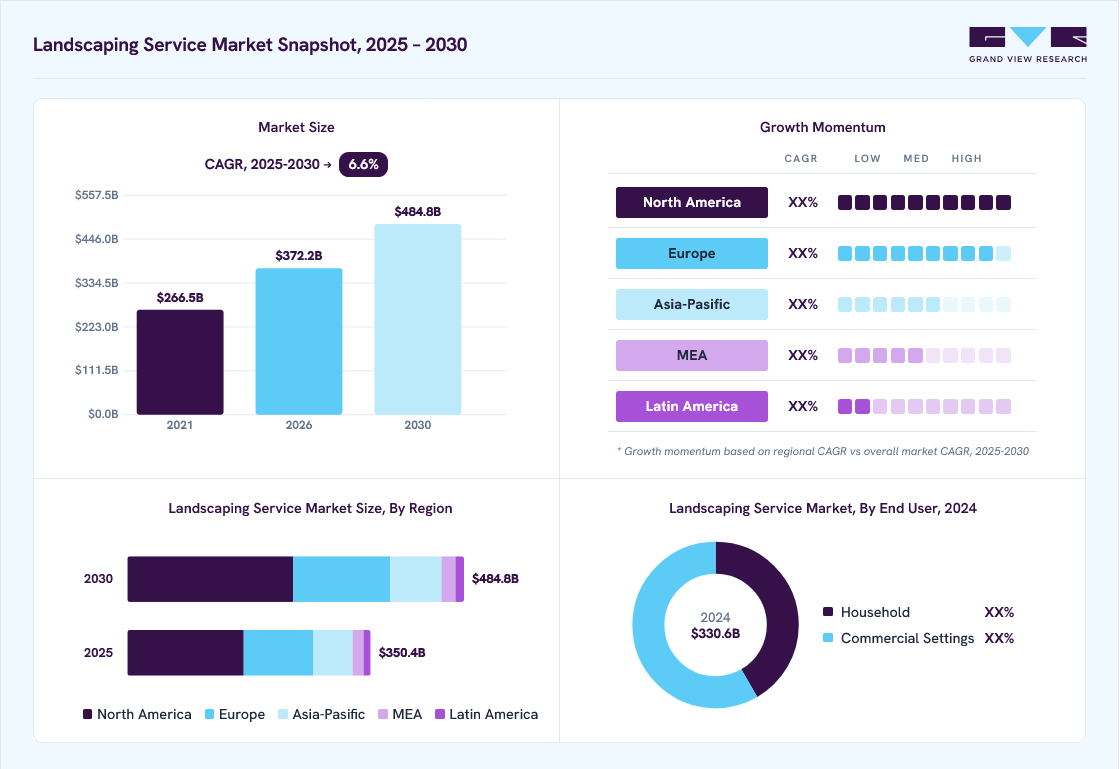
The Landscaping Solutions market in the United States runs under the NAICS market code 56173. This market primarily offers landscape care and upkeep services, including planting trees, shrubs, flowers, lawns or gardens. Market companies might also develop landscape strategies or construct pathways, keeping walls, decks, fences, ponds and comparable structures.
Associated terms covered in the Landscaping Services industry in the United States include lawn service, shrub service, tree service, outsource, arborist, pesticide, herbicide, mulch and fertilizer. Products and services covered in Landscaping Services market in the United States consist of Maintenance and basic services, business, Upkeep and basic services, residential and Design-build-installation services.
Eco-Conscious Maintenance At Regional Service Facilities
The Performance chapter covers detailed analysis, datasets, comprehensive current performance, sources of volatility and an outlook with forecasts for the Landscaping Solutions industry in the United States. Questions answered in this chapter include what's driving existing industry performance, what affects market volatility, how do effective businesses conquer volatility, what's driving the market outlook.
The Products and Markets chapter covers comprehensive product or services segmentation and analysis of major markets for the for the Landscaping Providers industry in the United States. Concerns responded to in this chapter include how are the market's product or services performing, what are innovations in industry products and services, what service or products do effective companies offer and what's influencing demand from the market's markets.

Latest Posts
Standardizing Key Sustainability Benchmarks for 2026

How to Convert to Native Landscapes Efficiently

Why Pacific Green Landscape Maintenance is Key to ESG Accuracy